

 Australia
 USA
USA UK
UK Ireland
 Canada
Clearing a Two-Year Year-End Accounts Backlog
How a Dublin Accounting Firm Cleared a Two-Year Year-End Backlog and Rebuilt Client Trust with Aone Outsourcing Solutions.
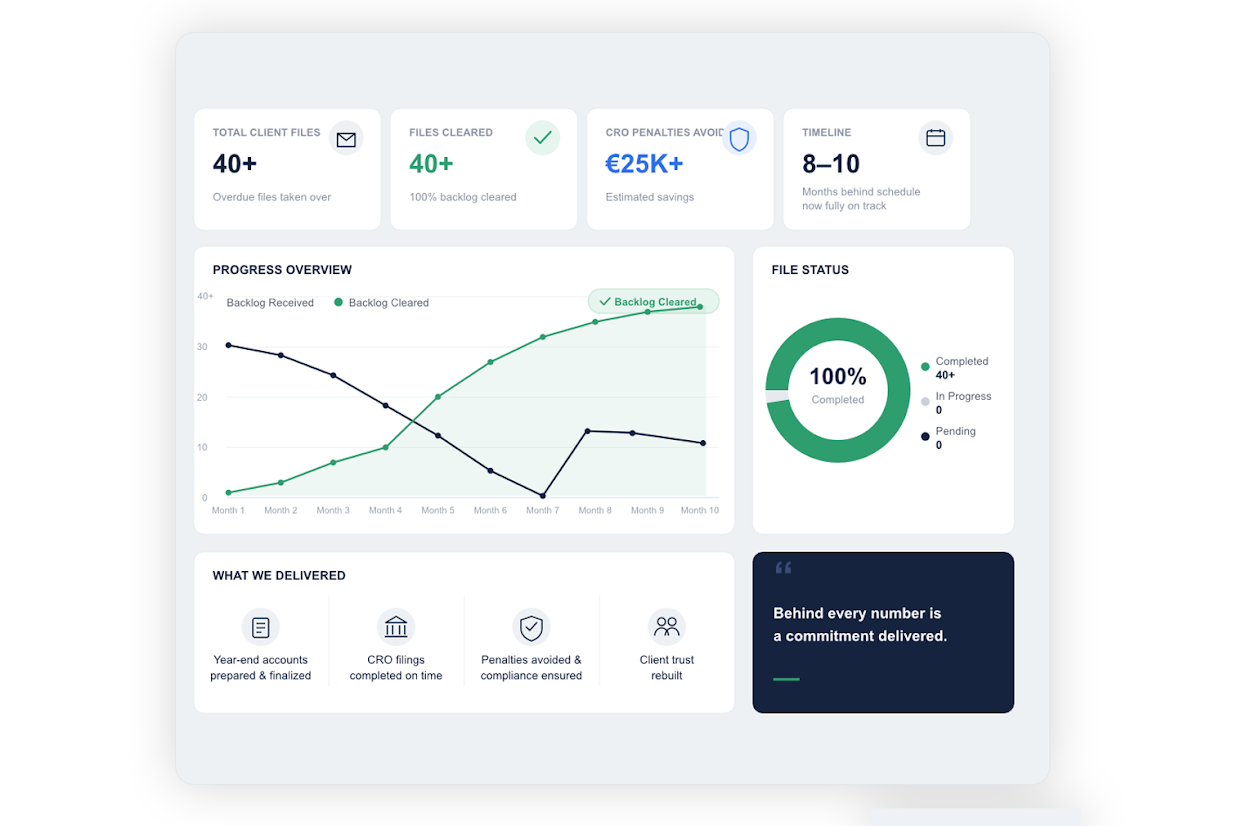
Overdue files cleared
CRO late-filing penalties
Months to fully clear
Less prep time per client
Well-established. Under-resourced.
A well-established but under-resourced accounting practice in Dublin that is serving small and medium-sized businesses across retail, hospitality, and professional services. Year-end accounts preparation and CRO filing are the major parts of their annual workload, alongside tax compliance and bookkeeping support.
The firm had a very small team that worked on this entire project and was always pushed for time, with several deadlines competing for attention. Turnaround was coming slowly, and stress levels were beginning to take their toll. So the director went to Aone Outsourcing Solutions, not to catch up on the backlog but to establish a process that would keep the firm from being backlogged again.
What Aone's file-by-file audit found
Before proposing a solution, Aone conducted a file-by-file review of the backlog to understand what was causing the delays. Three issues stood out:
No prioritisation system
The newest requests were often worked on before older, more overdue ones.
No standard working paper format
Every file had to be understood from scratch before work could begin.
Reactive, not scheduled work
Accounts were prepared only when a client chased, not on a fixed internal calendar.
How Aone Worked on the Solution?
Rather than simply adding capacity to the existing process, Aone rebuilt the year-end workflow from the ground up:
Before and After, by the Numbers
| Metric | Before | After |
|---|---|---|
| Average accounts delay | 8-10 months | On Schedule |
| Clients with CRO late filing penalties | 12 | 0 |
| Clients at risk of losing audit exemption | 6 | 0 |
| Backlog size | 40+ | 0 |
| Standardised working paper format | No | Yes |
| Time to prepare accounts (avg per client) | 15–20 hrs | 8–10 hrs |
How Long It Took to Change the Scenario
Month 1
File audit completed, backlog triaged and ranked by urgency.
Month 2–3
Oldest and highest-risk files cleared first, in structured weekly batches.
Month 4
Remaining backlog cleared, all clients brought current.
Month 5 Onward
Rolling filing calendar in place, no client working within 60 days of deadline.
"We knew we had a backlog problem, but we didn't realise how much of our time it was quietly costing us until it was gone. Now we're having actual conversations with clients about their business, not just apologising for being late."
Is Your Year-End Backlog Quietly Growing?
If accounts are slipping further behind every year, the fix usually isn't more hours, it's a better process.